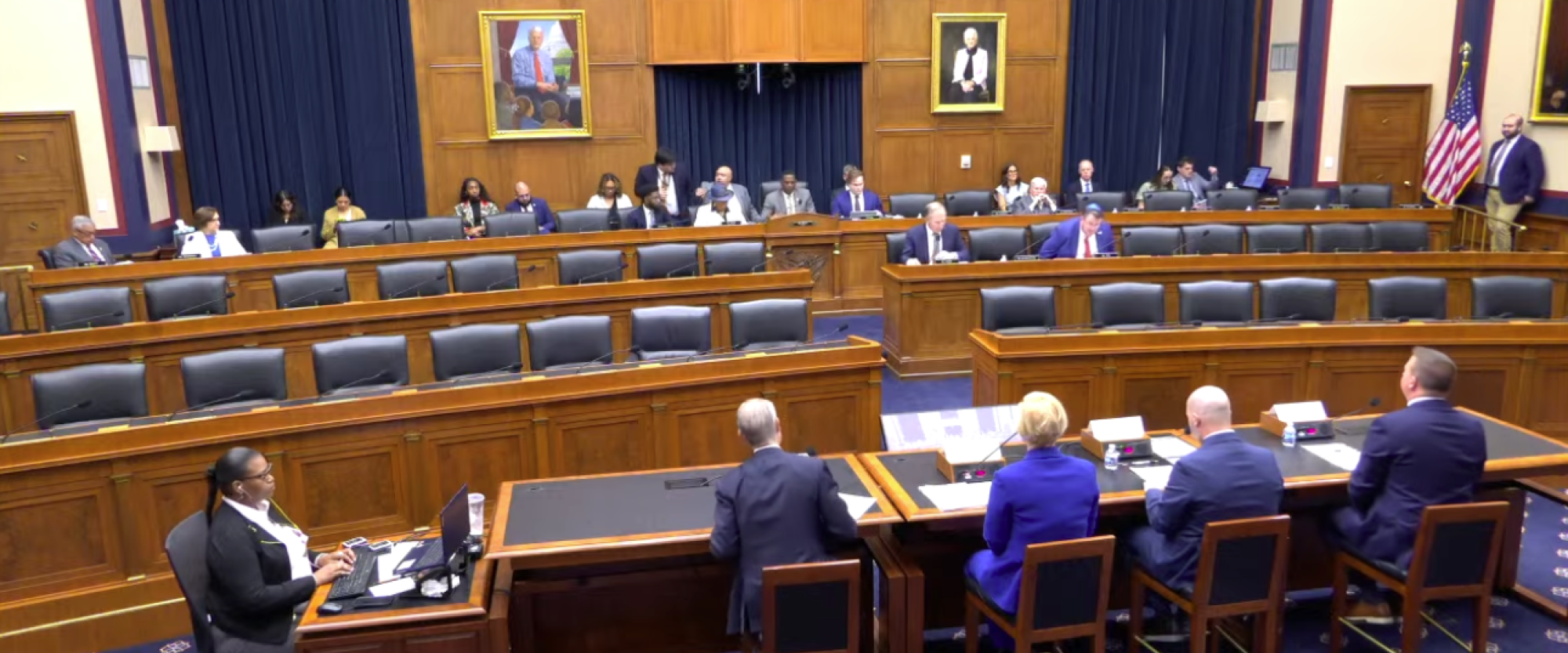
On June 3, 2026, our CEO testified before the U.S. House of Representatives Subcommittee on Higher Education & Workforce about AI and higher education. We wanted to share her full testimony with you here.
Chairman Owens, Ranking Member Adams, and Members of the Subcommittee:
Thank you for the opportunity to testify today.
My name is Bridget Burns, and I serve as CEO of the University Innovation Alliance, a national consortium of 19 public research universities serving more than 570,000 students across the country.
Over a decade ago, the University Innovation Alliance was formed around a national challenge: increasing the number of college graduates to strengthen American economic competitiveness. Over the past 12 years, our member institutions produced more than 180,000 additional graduates above baseline projections, including a 51 percent increase in graduates from low-income backgrounds. While our first decade focused on helping more students earn degrees, our next decade is focused on ensuring those degrees translate into economic mobility, career success, and stronger outcomes for the students, communities, and states we serve.
We achieved those results by doing something higher education rarely does: innovating together. Over the years, our campuses have developed, tested, and scaled new strategies for improving student success, deploying predictive analytics and machine learning to better anticipate when a student is struggling and match them with the right support at the right time, improving student communications, or creating completion grants to ensure seemingly small unpaid debts didn’t keep someone from finishing their degree. We used AI-driven chatbots to help incoming freshmen navigate the maze of enrollment tasks so they don’t slip through the cracks before they even start. And, critically, we have scaled what works across our campuses and open-sourced our learnings with our peers.
This is how the UIA operates, as a national laboratory for innovation. We represent many of higher education’s early adopters and solution creators. Our model is not simply to innovate within our own campuses, but to openly share what we learn with the broader sector so that students beyond our own institutions can benefit.
That philosophy shapes how we think about artificial intelligence.
This is not higher education’s first encounter with AI. Our campuses have leveraged AI and machine learning to improve student outcomes for more than a decade. But the pace and scale of generative AI adoption is unprecedented. In less than two years, institutions have gone from asking whether students would use these tools to grappling with a reality in which their use has become commonplace. A 2025 survey of 1,047 students across 166 public and private two- and four-year institutions found that 85 percent reported using generative AI for coursework (Flaherty, 2025).
Through my role at the University Innovation Alliance, I have had the opportunity to convene and learn from university leaders, faculty, technologists, and practitioners across our member campuses and beyond as they navigate the opportunities and challenges presented by AI. What I want to share today is less about AI as a technology and more about what it reveals about higher education’s ability to adapt responsibly amid rapid change and to meet the continuing call to further American economic competitiveness.
Artificial intelligence is transforming every function of higher education simultaneously: teaching and learning, student advising, workforce preparation, research, procurement, governance, privacy, mental health, and student support. Institutions are trying to govern responsibly in an environment where technology changes constantly, expertise is still emerging, and risks and opportunities are unfolding simultaneously.
One of the reasons navigating this transformation is so challenging is that AI does not fit neatly within traditional organizational structures. When we convene campuses to discuss AI, one of the first questions is often: ‘Who is responsible for this work?’ Unlike most institutional initiatives, AI simultaneously affects academic affairs, research, information technology, legal affairs, procurement, student support, workforce development, and faculty governance. As a result, many institutions are developing cross-functional approaches that bring together diverse stakeholders to shape strategy and governance. The University of Utah, for example, has engaged voices from across the institution while openly sharing resources, guidance, and lessons learned through its public AI initiatives. AI is not simply a technology challenge. It is an institutional transformation challenge. Campuses across the country are independently trying to answer the same questions:
- How do we support innovation while protecting student and faculty privacy?
- How do we prepare students for an AI-driven workforce while maintaining academic integrity?
- How do we evaluate AI vendors and contracts responsibly when most institutions lack deep internal expertise in these areas?
Most institutions are not resisting AI. But most are navigating it alone.
Right now, thousands of these conversations are happening across higher education: legal reviews, procurement negotiations, classroom experimentation, faculty governance discussions, but with very few mechanisms to accumulate and share what institutions are learning. As a result, campuses duplicate work, institutions can repeat mistakes, and expertise remains fragmented.
Most concerning of all, under-resourced campuses are often left to navigate highly complex decisions on their own. One of my greatest concerns is that AI could unintentionally widen the gap between well-resourced and under-resourced institutions and further the digital divide we are already seeing emerge. The campuses with the most resources will move faster, attract more expertise, negotiate stronger vendor agreements, develop governance frameworks, and build AI literacy programs. Meanwhile, institutions with fewer resources are often being asked to navigate the same challenges with significantly less capacity.
Whether a student benefits from responsible AI adoption should not depend on where they happen to enroll. America’s future workforce is being educated across thousands of colleges and universities, not just a handful of well-resourced institutions. If AI becomes another force that concentrates advantage among a small number of campuses, we will miss an enormous opportunity. America’s economic competitiveness depends on our ability to develop talent everywhere, from rural communities in North Carolina to Salt Lake City.
If America wants to remain competitive, we need a strategy for accumulating and sharing the learning, insights, and solutions being developed across higher education in ways that benefit students nationwide, not just those attending a handful of well-resourced institutions.
Our campuses are already demonstrating what responsible AI implementation can look like in practice. Importantly, they are not treating AI innovation as a proprietary competitive advantage. They are intentionally building and sharing solutions designed to help move the broader sector forward. Our campuses are actively studying what each other is doing, and we are openly disseminating what we are learning in real time. We believe that is the right approach for higher education.
Four examples illuminate what is possible:
- Arizona State University developed “Triangulator” to address slow and inconsistent transfer credit evaluation, a process that traditionally requires staff to manually compare catalogs and syllabi course by course, often delaying decisions for weeks or months. Rather than replacing people, the tool uses AI to accelerate the human workflow by organizing public course data, identifying likely equivalencies, and presenting recommendations for staff review. Human experts remain the final decision-makers, as they should for all consequential education decisions. ASU chose to make the solution open source so other institutions can benefit as well. Already, seven other UIA campuses are working toward scaling this tool. This is a strong example of the kind of intentional, well-designed solution being created by a single campus that does not treat AI as a competitive advantage, but rather sees it as a tool to solve a long-term challenge facing our sector while bringing the rest of higher education along.
- Purdue University was the first institution in the country to integrate AI literacy into its graduation requirements. Rather than treating its work as a competitive advantage, Purdue has openly shared implementation lessons, governance considerations, and emerging best practices through our network. Institutions across the country are now studying these approaches as they consider how to prepare their own students for an AI-driven workforce.
- At the University of California, Riverside, writing faculty were among the first to experience the impact of generative AI in the classroom. Rather than ignore the technology or simply prohibit its use, they thoughtfully designed an AI-enabled critical thinking support tool that provides personalized coaching to students. The tool functions as a Socratic tutor: it analyzes student work and guides students through questioning rather than rewriting, helping them better understand assignment objectives and reinforce authentic learning. The approach is currently being tested and evaluated so it can be refined and shared. Initial results suggest the guided AI assistance is improving learning outcomes while preserving student self-sufficiency. As the faculty put it: it isn’t that there are more students getting A’s, it’s that far fewer are getting D’s and F’s, and instead achieving understanding of the assignment objectives.
- Our campuses are working together to tackle a longstanding challenge that has frustrated students for decades: the disconnect between choosing a major and understanding future careers. As part of this effort, our campuses are identifying, and testing AI-enabled tools that can provide students with more personalized guidance and real-time workforce insights. The University of Utah has already developed UGuide, an AI-enabled tool that helps students explore academic pathways and career opportunities in a more personalized way. Utah is piloting the approach and preparing to share its insights and lessons learned across the broader UIA network.
These are just some examples from across the UIA that demonstrate that responsible AI adoption is possible. They also demonstrate something equally important: this level of coordination, transparency, and shared learning does not happen automatically. It happens because there is intentional infrastructure supporting trusted collaboration, peer learning, open dissemination, implementation support, and cross-campus coordination. We are fortunate to have that infrastructure through the UIA. But we are deeply concerned about the wider higher education sector, the close to 4,000 degreegranting institutions in our country.
Universities play a unique role in moments like this. Research institutions are designed to rigorously test, evaluate, and study emerging technologies independently and ethically over time. The kinds of questions we should be asking about AI’s impact on learning, workforce readiness, student well-being, privacy, and institutional operations are precisely the kinds of questions research universities are built to investigate.
But that work depends on research infrastructure and operational capacity that is itself under pressure. The research offices, compliance systems, data governance structures, and interdisciplinary teams that support responsible experimentation are often funded through indirect cost recovery and broader research infrastructure investments. When those systems are weakened, it erodes institutional capacity to conduct the kind of careful, independent evaluation society needs during a period of rapid technological change.
What is also missing right now is a coordinating infrastructure for higher education similar to what has emerged in K-12 through the EdSAFE AI Alliance: a trusted, shared mechanism for institutions to develop governance frameworks, navigate procurement, build AI literacy, and share what is working (and what is not).
The University Innovation Alliance and our partners have developed a concept for the higher education equivalent. This framework would create common governance resources, communities of practice, faculty working groups, employer skills exchanges, implementation playbooks, and open-access tools so institutions can learn together rather than operate in isolation. We believe this kind of collaborative infrastructure is essential because no single institution has fully solved these challenges yet.
Creating coordinating infrastructure is important, but incentives matter as well.
Federal policy has spent decades rewarding institutions for developing innovations. The AI era requires us to also reward institutions for sharing them.
One of the most effective ways to do this would be to prioritize multi-institution partnerships in federally funded AI initiatives. When colleges and universities are encouraged to work together, share lessons learned, test solutions across diverse settings, and openly disseminate effective practices, innovation spreads more quickly and more institutions benefit.
We have seen the power of incentive structures to drive collaboration around difficult challenges. Competitions such as the XPRIZE demonstrated that when incentives are aligned around solving important public problems, organizations come together, combine expertise, and accelerate innovation. The same principle can be applied to higher education and AI. Federal AI initiatives should encourage collaborative demonstration projects and learning networks that bring together institutions with different missions, student populations, and strengths. Such an approach would help ensure that effective practices are not confined to a small number of well-resourced institutions but can be tested, refined, and adopted broadly across the country.
If we want every student in America to benefit from AI responsibly and safely, then higher education cannot navigate this transformation institution by institution and campus by campus alone.
One of the risks of this moment is that every institution uses AI primarily to gain an advantage over its peers. Imagine if colleges and universities focused only on becoming more efficient, attracting more students, or improving their own competitive position. Now imagine those same institutions working together to use AI to address workforce shortages, improve student success, accelerate scientific discovery, strengthen economic competitiveness, advance energy independence, improve health outcomes, address the challenges of an aging population, and develop solutions to childcare and other barriers that prevent Americans from fully participating in our economy.
The greatest opportunity presented by AI is not that individual institutions become smarter. It is that institutions become capable of learning, solving, and innovating together at a scale that was previously impossible. Some of the most important challenges facing America are simply too large and too complex for any one institution, company, or state to solve alone.
Other nations are organizing AI around national priorities. America has an opportunity to organize AI around national problem-solving, leveraging the unmatched capacity of our colleges and universities to strengthen economic competitiveness, scientific leadership, and opportunity for future generations. Higher education has a responsibility to ensure AI is used not only to improve our institutions, but also to accelerate our collective ability to solve the problems that will define America’s future.
The question before us is not whether AI will transform higher education. It already is. The question is whether we will build the partnerships, infrastructure, and incentives necessary to ensure every student and every institution can benefit from that transformation.
Watch the full hearing.
Read the official testimony in the congressional record.
Opening Statement: Rep. Burgess Owens (R-UT)
Witnesses:
- Mr. Jonathan Fozard, Chief Information Officer, Florida State University
- Dr. Dave Duke, Chief Product Officer for Higher Education, McGraw Hill
- Dr. Bridget Burns, CEO, University Innovation Alliance
- Mr. Michael B. Horn, Author & Adjunct Professor, Harvard Graduate School of Education