
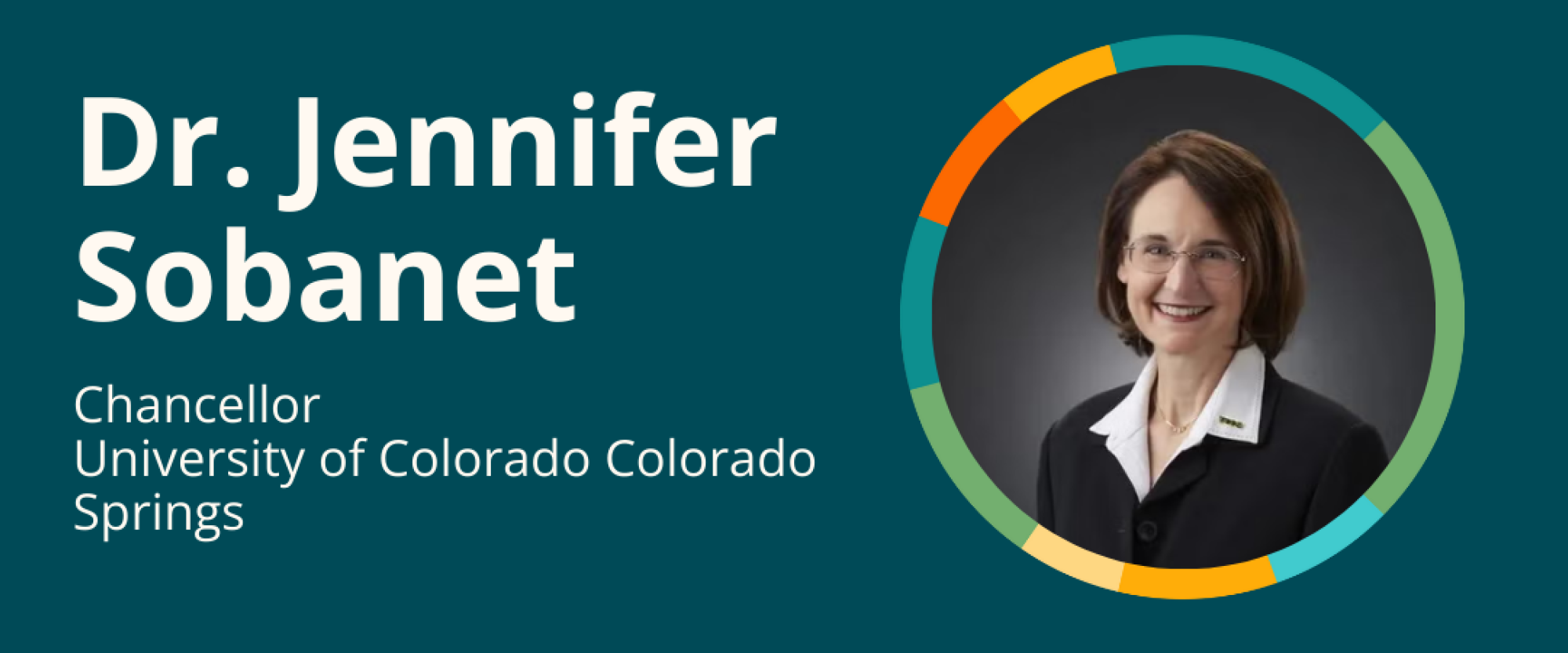
Higher ed leadership is evolving in visible and invisible ways. It’s not just who steps into these roles, but the range of demands they must shoulder from day one. Institutions need leaders who can combine operational clarity with the ability to lead through uncertainty, hold emotion, and stay grounded when their communities face crises.
On The Innovating Together Podcast, Dr. Jennifer Sobanet, chancellor at the University of Colorado Colorado Springs, talks openly about what this new reality looks like. Her path through business and finance, paired with a deeply human approach to leadership, reflects the blend of skills colleges and universities will increasingly depend on.
Developing Leadership Capacity in Higher Education
Chancellor Sobanet notes that personal values shape leadership, but values alone are not enough preparation for the complexity of running a modern university. Even experienced professionals step into new expectations when they enter senior roles. They manage people at a different scale, oversee budgets with broader implications, and make decisions that affect entire communities. Sobanet argues that the healthiest response is to adopt a growth mindset and treat leadership as a skill that continues to evolve.
One way she has built her capacity is through long-term executive coaching. “I've had an executive coach throughout my life as a leader. It hasn't been the same coach, because we need to learn different things at different times. I've always asked my coaches to help me learn and grow, and that only comes when we're challenged as human beings. I ask to see the stretch point that I need to learn at this moment.”
She points out that coaching works when leaders are willing to let someone see their blind spots and push them further than peers might. “The coaching relationship is actually a partnership between my supervisor, myself, and my executive coach, because oftentimes I can't see the things that I need to grow.”
Sobanet encourages leaders to widen their search beyond traditional higher ed circles. Coaches from the nonprofit and private sectors, as well as executive search firms, often bring different models of organizational effectiveness. In her experience, the goal is not to find someone familiar, but someone aligned with what she calls “your current head and heart space.” Interviewing multiple coaches helps leaders find the right fit and ensures they choose someone who can challenge them constructively.
For Sobanet, leadership capacity is not fixed. It is built through intentional learning, targeted support, and the willingness to examine how one leads. That orientation becomes even more important as institutions confront rapid change and increasing public scrutiny.
Nontraditional Career Pathways to Higher Ed Leadership
As colleges and universities adapt to new financial pressures, shifting public expectations, and rapid technological change, many institutions are turning to leaders with broader sector experience. Chancellor Sobanet is one of them. Her career began in economics, business, finance, and international studies, followed by roles in management consulting, corporate finance, and startup environments. She later moved into public and mission-driven work, bringing that operational foundation with her.
She explains how this background shapes her approach to the chancellorship. “Through the business side, budgeting, finance, and administration, I understand how to work with elected officials and look at the university through a different lens than most people do. And as we look at how we serve our students, we need to understand what our stakeholders are expecting of us.”
Sobanet argues that nontraditional leaders bring the skills needed. They often bring fluency in data-driven decision-making, an understanding of complex budgeting, and the ability to navigate political and public-sector dynamics. They also tend to arrive with an instinct for innovation, shaped by environments that expect iteration and adaptability. “My background allows me to emphasize creativity and innovation. And with the extensive, accelerated change in the higher education landscape these days, curiosity, creativity, and innovation are some of the most important things that we do here.”
She points to a recent initiative at UCCS as an example. The university launched C3 Innovation, a framework built around curiosity, creativity, and community to advance institutional purpose and elevate work across campus. Sobanet sees it as an illustration of how nontraditional leaders can help institutions reframe challenges and identify opportunities.
Her path underscores an emerging trend. Higher ed leadership no longer follows one predictable trajectory. Experience in finance, consulting, government, or nonprofit sectors can complement academic expertise and strengthen an institution’s capacity to meet new demands.
Leading Through Crisis in Higher Education
Campus leadership carries a responsibility that becomes most visible in moments of crisis. Only eight weeks into her role as chancellor, Dr. Jennifer Sobanet faced a series of tragedies at the University of Colorado Colorado Springs. A student killed two people in a residence hall. Months later, a well-known faculty member was murdered. Soon after, a student’s parent died accidentally at a sporting event. Each incident demanded immediate decisions while the campus community processed collective grief.
Sobanet describes it this way. “In a stretch of 12 months, I had to dig deep and understand how to show up as a centered, loving, but strategic and thoughtful leader to our university. What I didn't realize was how important it was for me to put on my own oxygen mask first and take care of myself so I could lead and serve others in the best way possible. Being a calm, compassionate, thoughtful person comes from what's in our hearts.”
These events underscored the emotional and operational dimensions of higher ed leadership. Sobanet notes that the first steps after a crisis require both transparency with system leadership and awareness of campus resources. She contacted the Lyda Hill Institute for Human Resilience immediately, recognizing the need for expert support.
“Addressing in the moment the personal side allowed me to show up as a better leader for the university instead of suppressing those emotions. Lyda Hill’s executive director Chip Benight quickly connected me up with help and actually, he connected the entire campus, because I knew we were all experiencing the trauma together and needed to come at this from a human lens.”
For Sobanet, the experience reinforced a core leadership principle. Institutions already hold many of the tools needed to respond to tragedy, and leaders strengthen trust when they activate those resources quickly and visibly. It is a reminder that effective crisis leadership depends not only on decisiveness but on knowing the people, departments, and expertise that sustain a campus in difficult moments.
Preparing Students and Leaders for the Future of Higher Education
Sobanet’s leadership philosophy integrates her analytical training with an intentional commitment to empathy, presence, and reflection. She explains that the turning point in her development was recognizing that effective leadership in higher education requires more than technical proficiency. It requires a disciplined human orientation.
“I try to be a leader who brings curiosity to everything that I do. I try to be more curious than convinced. Also, courage is one of the most important qualities, because without courage, our wisdom and experiences bear no fruit. And I try to bring compassion to my leadership. It has taken a lot of self-reflection to bring that forward, to understand that all of our work in higher education is people-centered. We have to bring that love for our fellow human beings into our work.”
Her approach reflects a broader shift across the sector. Colleges and universities are navigating polarized public debates, mental health concerns, staff burnout, and ongoing operational pressures. Leaders who succeed under these conditions are those who can hold tension, make decisions transparently, and still cultivate trust within their communities. Curiosity helps leaders question assumptions rather than defaulting to past practice. Courage enables them to act in ambiguous environments. Compassion ensures they attend to the human consequences of those choices.
For Sobanet, these capacities are not soft skills. They are the foundation for sustainable, credible leadership, especially when campuses face uncertainty or transition. She sees human-centered leadership not as a style, but as a requirement for institutions that aim to stay grounded and resilient through change.
The Future of Leadership in Higher Education
Chancellor Sobanet believes that higher education’s enduring mission is to prepare students for a world that changes faster than institutions do. She emphasizes that the value of college rests not only in disciplinary expertise, but in the human capacity students develop while they are with us. As she explains, “We like to say that we teach our students how to think, not what to think. The humanities have so much to do with that.”
She notes that today’s graduates will navigate multiple careers and contexts, which means adaptability, curiosity, and self-awareness are essential. “We want them ready to be adaptable and agile, remain curious, and keep saying, ‘I wonder.’ It’s the beginning of so many great things.”
Her perspective brings the conversation full circle. The same qualities institutions hope to instill in students are the qualities leaders must model as higher education moves through an era of accelerated change. Curiosity, compassion, and the ability to stay grounded in complexity are no longer optional. They are the traits that will define effective leadership and guide colleges and universities into their next decade of work.
Note: This episode of the University Innovation Alliance’s Innovating Together Podcast originally aired on October 27, 2025. The podcast appears live on YouTube, Facebook, Twitter, and LinkedIn.
Resources Mentioned in This Episode
- University of Colorado Colorado Springs
Part of the University of Colorado System, UCCS began as a small commuter satellite school and is now one of the state’s fastest-growing universities with over 11.3K students. Its diverse, inclusive, innovative learning environment offers programs in liberal arts and sciences, business, engineering, and health sciences. It also includes teacher preparation undergraduate degree programs, and selected master's and doctoral degree programs. - Lyda Hill Institute for Human Resilience
The mission of this institute is advancing human resilience to adversity by designing evidence-based solutions through interdisciplinary research, healing therapies, and community training and empowerment. It strives to provide individuals, communities, and organizations with the tools needed to build mental health resiliency. - C3 Innovation
Housed in a library facility at the heart of the UCCS campus, the C3 Innovation program is a hub of multidisciplinary collaboration that connects students, faculty, and the community to push the boundaries of research and discovery.
Bios of Guest and Co-Hosts
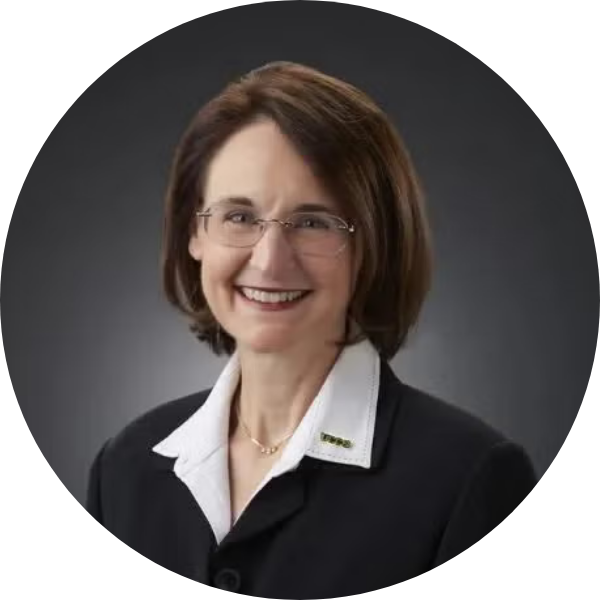
Since July 2023, Dr. Jennifer Sobanet has served as the Chancellor at the University of Colorado Colorado Springs. Prior to that, she joined the University of Colorado Denver in 2016, and as its Executive Vice Chancellor of Administration and Strategy, she led CU Denver’s strategic plan implementation, catalyzing strategic partnerships and innovation, and aligning the university’s resources with its vision. She stewarded administrative and financial strategy through incubating, resourcing, and operationalizing its strategic initiatives. Before joining CU, Dr. Sobanet was the acting Executive Director and Chief Operating Officer of the Colorado Department of Higher Education. Prior to that, she was Chief Financial Officer and Vice President of Finance and Administration at Front Range Community College and held financial, legislative, and academic roles at the Colorado Community College System. Earlier in her career, she spent nearly a decade in management consulting and corporate finance after serving as an economist and budget analyst in the State Office of State Planning and Budgeting. In addition to her administrative duties, Dr. Sobanet serves on the Colorado Springs Chamber and EDC Board and as a member of The Colorado Thirty Group. She was previously on the Denver Scholarship Foundation Board, was a Gates Family Foundation Harvard Fellow in 2014, and is a member of the Leadership Denver Class of 2014. She received her Ed.D. in leadership for educational equity in higher education from the University of Colorado Denver, her master’s in international studies from the University of Pennsylvania’s Lauder Institute, and her MBA in international financial management from the Wharton School of the University of Pennsylvania. As a Yeager Scholar at Marshall University, she earned a BS in economics.

Co-Host: Bridget Burns, Executive Director, University Innovation Alliance
As a trusted advisor to university presidents and policymakers, Dr. Bridget Burns is on a mission to transform the way institutions think about and act on behalf of low-income, first-generation, and students of color. She is the founding CEO of the University Innovation Alliance, a multi-campus laboratory for student success innovation that helps university leaders dramatically accelerate the implementation of scalable solutions to increase the number of college graduates.
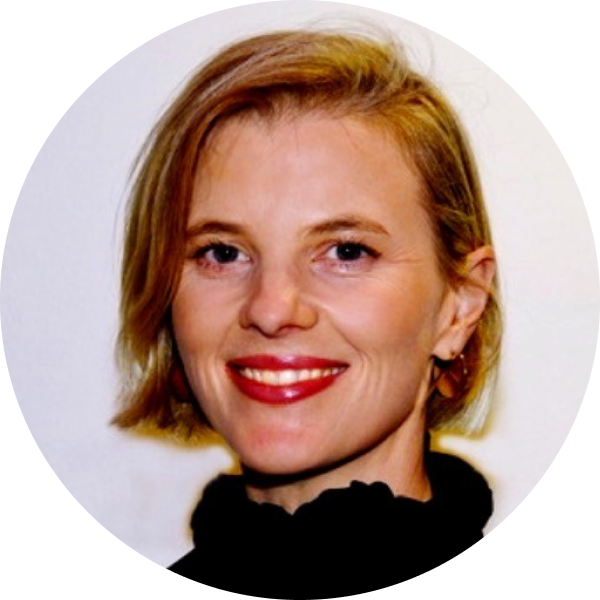
Co-Host: Sara Custer, Editor-in-Chief, Inside Higher Ed
Sara Custer became Inside Higher Ed’s editor-in-chief in 2024 after serving four years at Times Higher Education. At THE, she worked across departments to launch and grow the Campus platform, and then lead its editorial team. Prior to that role, she served as digital editor, helping to launch THE’s newsletter strategy and overseeing daily, weekly, and monthly publications. Ms. Custer was previously editor and senior reporter at The PIE News, a website and magazine covering the international education industry. She grew up in Cushing, OK., and earned a B.A. in English literature from Loyola University Chicago and an M.A. in international journalism from City, University of London. As a journalist, she has covered global higher education for more than five years.
About Innovating Together
Innovating Together is an event series that happens live on YouTube, Facebook, Twitter, and LinkedIn. It also becomes a podcast episode. Every week, we join forces with Inside Higher Ed and talk with a higher education luminary about student success innovations or a sitting college president or chancellor about how they're specifically navigating the challenges of leadership. We hope these episodes will leave you with a sense of optimism and a bit of inspiration.
Rate, Review & Subscribe
Learn why hundreds of people have rated the Innovating Together podcast 5 stars. Please join others and rate and review this podcast. This helps us reach and inform more people -- like you -- who are committed to helping more students succeed.
Click here, scroll to the bottom, tap to rate with five stars, and select “Write a Review.” Then be sure to let us know what you loved most about the episode. Also, if you haven’t done so already, subscribe to the podcast. You'll never miss an episode.
Other Ways to Enjoy this Post

Follow us to Join LIVE: