Practical tools and tested approaches from UIA universities to identify high-DFW courses, help students recover after an unsuccessful attempt, and support faculty in redesigning courses for greater student success.
Why This Matters
A small number of high-enrollment courses can become major barriers to student progress. When students receive a D or F or withdraw from these courses, the consequences can include delayed graduation, additional tuition costs, and a greater risk of stopping out.
High-DFW courses are courses with high rates of students receiving a D or F or withdrawing. These rates can help institutions identify places where large numbers of students are getting stuck on the path to a degree.
UIA universities worked together to address this challenge from both sides: help students recover when they do not successfully complete a course and help faculty improve courses so fewer students struggle in the first place.
Two Ways to Tackle the Problem
1. A student gets a D, F, or withdraws from a required course. What happens next?
Academic Recovery
For many students, a single course can become a major obstacle on the path to a degree. High-enrollment gateway courses often sit at critical points in a student’s academic path. When students do not successfully complete them, they can fall behind in a course sequence, face additional costs, change majors, or stop out altogether.
Academic Recovery is designed to keep one unsuccessful course from derailing a student’s path to a degree.
UIA universities identified students who received a D or F or withdrew from high-impact courses and tested proactive ways to help them successfully return to and complete those courses. Rather than waiting for students to find their own way back, campuses used data to identify who needed support, reached out directly, and addressed the academic, financial, and logistical barriers preventing students from trying again.
What UIA Universities Found
Across participating UIA institutions, Academic Recovery reached more than 1,400 students in more than 100 courses. Students participating in Academic Recovery passed their retaken courses at rates 17% higher on average, campuses saw higher term-to-term retention, and several institutions generated net-positive revenue through improved student persistence.
- 1,400+ students
- 100+ courses
- 17% higher retake pass rates
- Higher retention
Put Academic Recovery to Work on Your Campus
Academic Recovery Playbook
How to design, implement, and scale an Academic Recovery program.
Open the Playbook
Academic Recovery Companion
Additional tools and resources to support implementation.
Open the Companion
Diagnostic Toolkit
Identify where Academic Recovery could have the greatest impact on your campus.
Use the Diagnostic Toolkit
Evidence Brief
See the results and evidence from UIA campuses that tested Academic Recovery.
See the Evidence
2. How do we reduce the likelihood that students struggle in these courses in the first place?
Faculty-Led Innovation
Faculty are closest to the teaching and learning experience. UIA universities tested ways to give faculty the support, structures, and tools to redesign high-impact and gateway courses and improve student success.
Faculty tested approaches including active learning, mastery-based pacing, clearer course structures, and targeted use of digital tools. Across redesigned courses, campuses saw early evidence of improved pass patterns, reduced D and F rates in key courses, stronger engagement, and greater clarity and confidence reported by students and faculty.
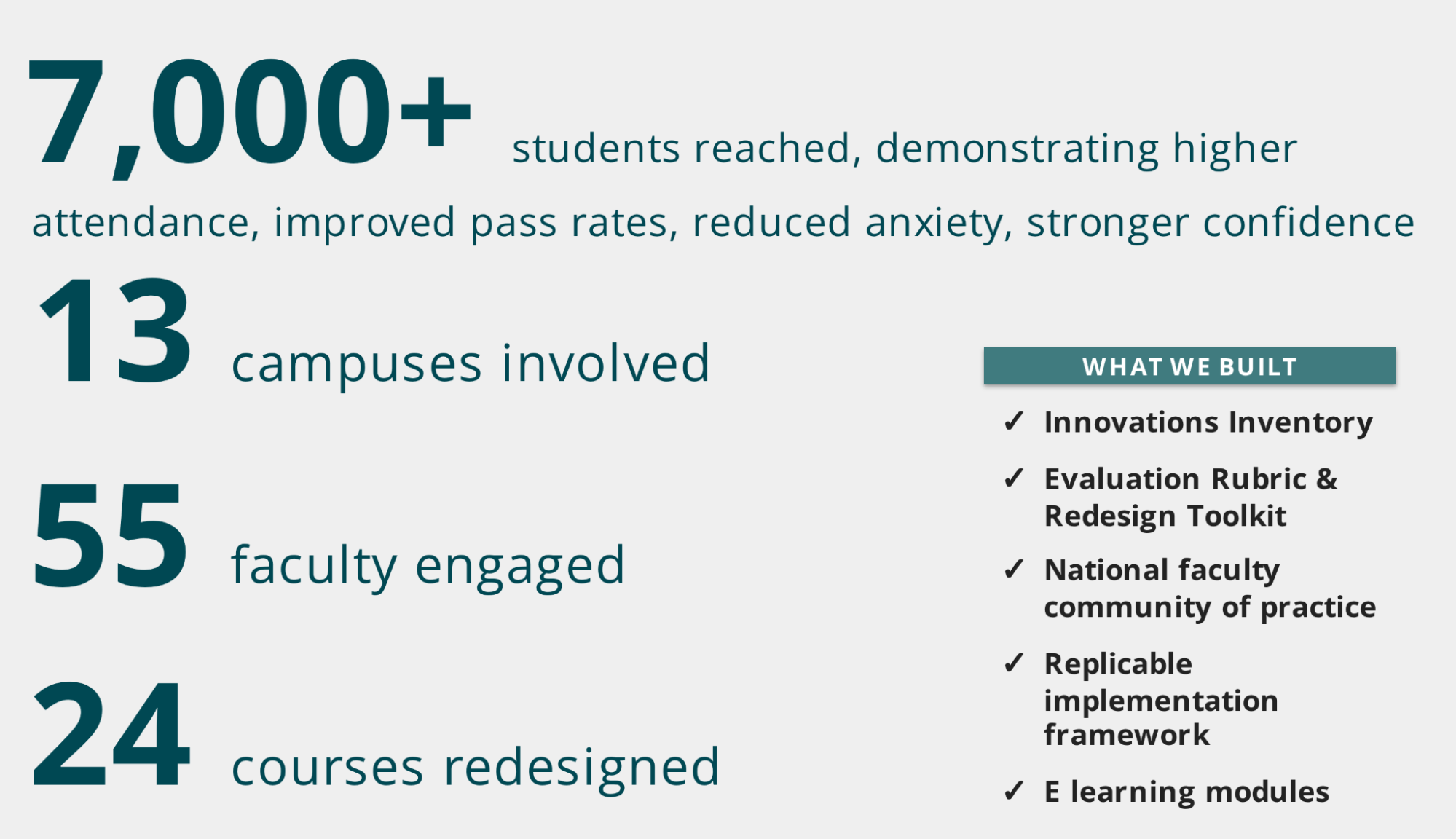
The work also identified a larger challenge: promising faculty innovations often remain isolated within individual courses or departments. The Faculty-Led Innovation resources help institutions identify what is working and spread effective approaches across more courses and students.
Help Faculty Improve Gateway Courses
Faculty-Led Innovation Playbook
Build the institutional conditions needed to support and scale faculty-led course redesign.
Open the Playbook
Innovation Evaluation Rubric
Assess promising teaching and learning innovations and their potential for broader use.
Use the Rubric
Learning Innovations Inventory
Explore evidence-informed approaches faculty can use to improve student success in high-DFW courses.
Explore the Inventory
Not Sure Where to Start?
I want to understand where students are getting stuck on my campus.
Start with the Diagnostic Toolkit.
Use the Diagnostic Toolkit
I want to help students who have already struggled in a course.
Start with the Academic Recovery Playbook.
Build an Academic Recovery Program
I want to improve high-DFW courses themselves.
Start with the Faculty-Led Innovation Playbook.
Support Faculty-Led Improvement
I want to understand the issue before deciding where to start.
Take the Self-Paced Learning Modules.
Start Learning
Self-Paced Learning for Faculty and Academic Leaders
Want to better understand high-DFW courses and the approaches institutions can use to improve student success?
UIA developed self-paced learning modules that introduce the problem, share research-based approaches to faculty-led learning innovation, and provide practical frameworks for getting started.
Explore the Self-Paced Modules
Who These Resources Are For
These resources are designed for:
- Faculty
- Provosts and academic affairs leaders
- Student success leaders
- Teaching and learning centers
- Institutional research and data teams
- Department chairs and academic leaders
- Others responsible for improving student success in high-enrollment and gateway courses
Developed with UIA Universities
These resources grew out of collaborative work across UIA member institutions to test approaches, learn across campuses, and turn what worked into practical resources other institutions can use.
Academic Recovery Participating Institutions
- Arizona State University
- Georgia State University
- North Carolina A&T State University
- Oregon State University
- University of California, Riverside
- University of Central Florida
- University of Colorado Denver
- University of Illinois Chicago
- University of Utah
- Virginia Commonwealth University
Faculty-Led Innovation Participating Institutions
- Arizona State University
- Iowa State University
- Michigan State University
- North Carolina A&T State University
- Purdue University
- University at Buffalo
- University of California, Riverside
- University of Colorado Denver*
- University of Illinois Chicago
- University of Maryland, Baltimore County
- University of Massachusetts Amherst
- University of New Mexico
- University of Utah
- Virginia Commonwealth University
*Participated in project focus groups.
With Thanks to Our Generous Philanthropic Partners
This work was made possible with support from Ascendium Education Philanthropy and The Frederick A. DeLuca Foundation. We are grateful for their investment in helping UIA universities test, learn, and develop practical approaches that can improve student success and be shared broadly across higher education.